My Senior Project I Created along with my collages a Hybrid MRV system that merges between Satellite data and in-location sensor networks and forecast feature data

This Project Idea started as we noticed that a global Smart-CDR Competition was starting soon. We thought about joining the competition and representing the college. It would also be our Senior Graduation Project.
The Project is about the M in MRV system. M stands for Monitoring. There is also a little bit of V, which stands for Verification. We decided to merge both existing current systems. Our goal was to create a system with fewer limitations than either of them.
Satellite Systems has a large range. However, the methods it is forced to use in space to sense environmental and pollution gases make it inaccurate. It is not fast enough in the monitoring part as it takes a few months for the data to be accessible for analysis.
Sensor Networks are More Accurate but much more expansive to build for the range it provide compared to Satellites. also the current systems are immobile due to their usually huge sizes.
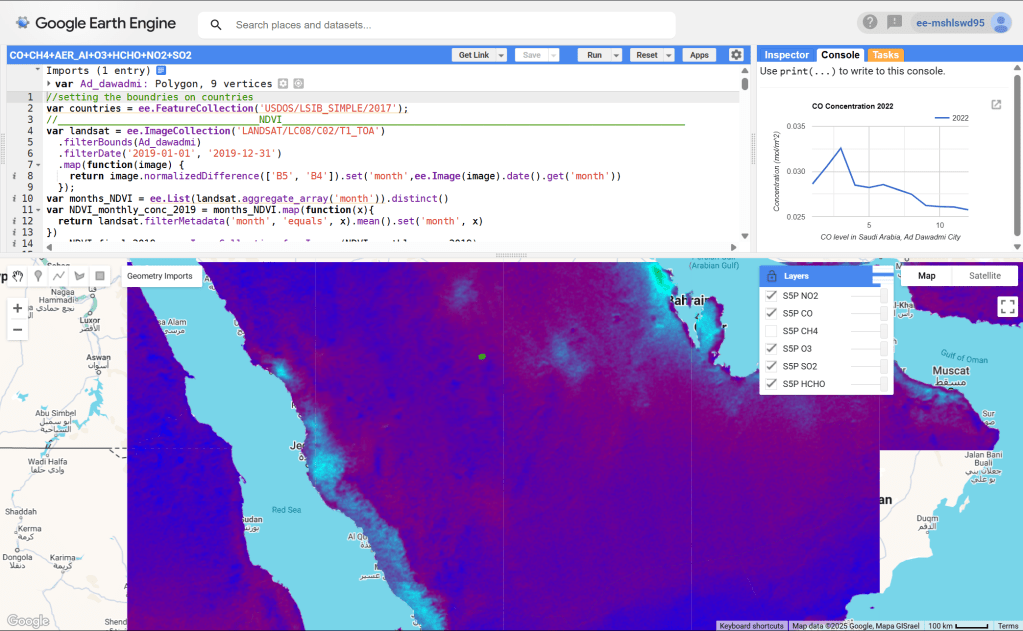
We merged them both with a Sensor Network of ours for demonstration purposes. We got the Satellites from Google Earth. This gave us access to Datasets from Sentinel-5P and Landsat-8 Satellites. We also got OCO2 Satellite data from NASA GES DISC Website.
For the Sensor Network, we gathered our data from MQ Series sensors and a standalone NDIR CO2 sensor. For the central transmitting node, we decided to use ESP32 for its Wi-Fi capabilities. These features allow us to place this cluster anywhere. It also enables us to access the data it detects.
We Use Python for the Cleaning Null values, Unifying Units and formats, Merging and adding weights. We calculate correlations. We use the correlations data to determine which data is going to be trained together. We also identify which data are irrelevant. we also used python to train a Random tree Regression model, we trained on 20% then foretasted the left over 80% to calculate the accuracy and then trained it again on the whole data set and made it forecast the next 12 months, and it was made in way where it will continue to consume new data coming from both systems and compare them with the foretasted data to Calculate accuracy and retrain to improve it forecasting ability
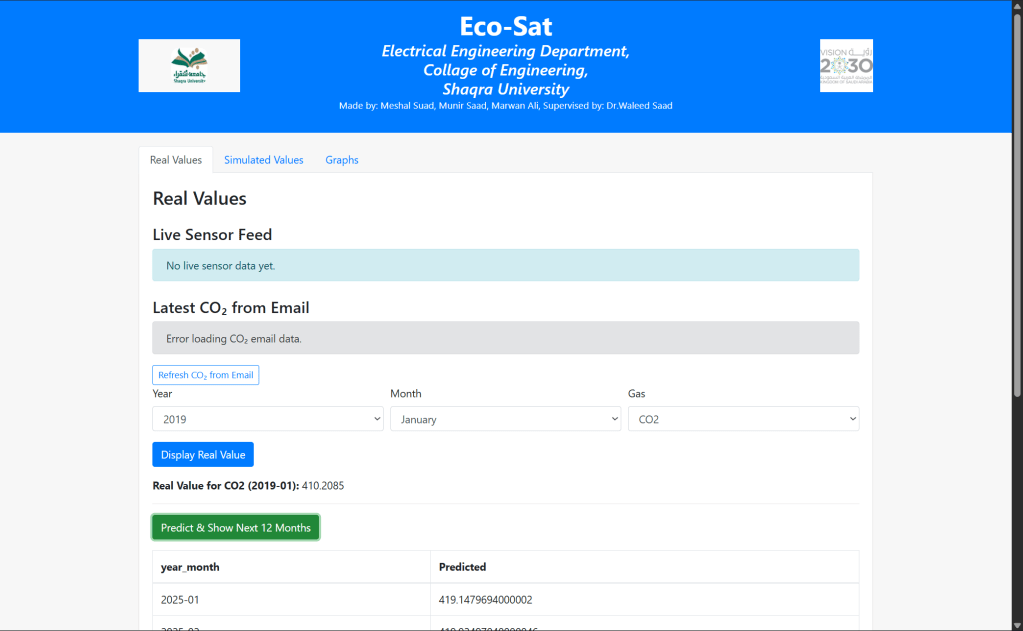
We got a Web Interface Deployed to Heroku, its running currently, but the sensor network is not running right now.
Contributors: Meshal Saud Meshari Alotaibi and Marwan Ali Merghni.
Supervised by Dr. Waleed Saad.
Date: Completed 2025/5
 Meshal Saud Alotaibi's Portfolio